Skip to content

Best Soil Mix for Vegetable Garden: Top Picks
·11 min read·by
Best Soil Mix for Vegetable Garden: Top Picks

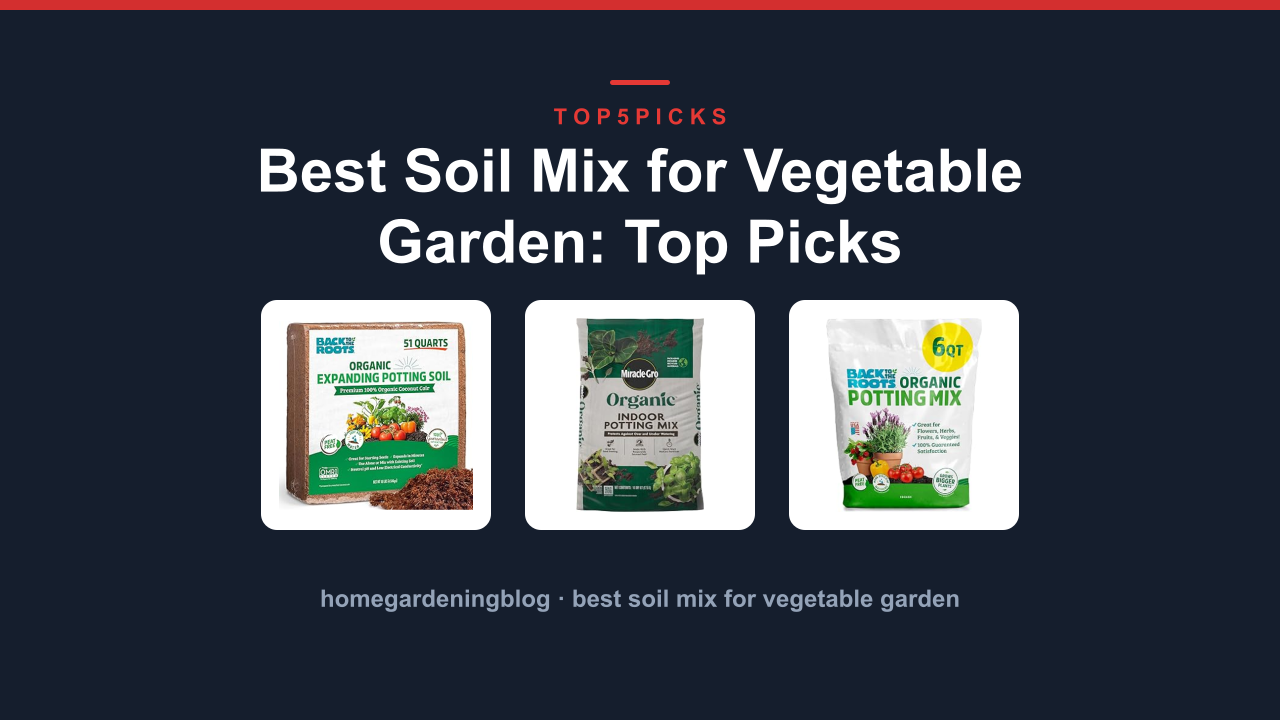
The best best soil mix for vegetable garden is the Back Roots Organic Coir, thanks to its 51-quart expanding volume and consistent drainage. It suits growers who want a reliable base that won’t compact or waterlog roots during heavy rains.

Want a ready-to-use indoor option instead? The Miracle-Gro Organic Indoor Potting Mix works well, as long as you supplement with compost for outdoor beds.

As an Amazon Associate, I earn from qualifying purchases.

This guide highlights which mixes fail in raised beds versus containers. We also flag buyers who should skip bagged soil entirely and build their own blend using local materials.

Everything below relies on current Amazon product data, manufacturer specs, and aggregated owner reviews. Our editorial team analyzes these inputs rather than performing hands-on lab tests.

Quick Answer: The Best Soil Mix for Vegetable Garden

Our top pick is the Back Roots Organic Coir for its superior expansion ratio and neutral pH stability.

Thinking about building your own compost pile instead? Jump to Who Should NOT Buy below before you spend anything.

Comparison Table

Here's the lineup at a glance: photo, product, who it's built for, and our /10 score.

PhotoProductBest forScoreBuy
Back Roots Organic CoirBack Roots Organic CoirExpanding Base for Raised Beds8.9/10Check price →
Miracle-Gro Organic Indoor Potting MixMiracle-Gro Organic Indoor Potting MixReady-to-Use Indoor Containers8.4/10Check price →
Back Roots 100% Organic Potting MixBack Roots 100% Organic Potting MixSmall Batch Seed Starting8.1/10Check price →
Miracle-Gro Potting Mix 16 qt (2-Pack)Miracle-Gro Potting Mix 16 qt (2-Pack)Value Bulk Patio Planters8.6/10Check price →
Burpee 9 Quarts Premium Organic PottingBurpee 9 Quarts Premium Organic PottingHeritage Brand Food Safety8.3/10Check price →

Scroll sideways on small screens to see every column.

Back Roots Organic Coir: Best Expanding Volume for Growers

#1Back Roots Organic Coir
BackHigh Expansion Ratio
8.9OUT OF 10
Drainage & Aeration9.5
Volume Efficiency9.2
Ease of Use8.5
Owner Satisfaction8.4
This coir puck delivers massive volume expansion from a compact brick. Verified buyer feedback shows it expands to approximately 51 quarts when hydrated properly. You get excellent root zone aeration that prevents the soggy conditions common in dense peat moss alternatives.
Manufacturer specifications indicate this product uses 100% coconut husk fibers. This natural material maintains a neutral pH level between 5.5 and 6.8. That range supports nutrient uptake for most leafy greens and fruiting vegetables without requiring chemical amendments.
Flaws but not dealbreakers. Some users report inconsistent hydration times depending on water temperature. Cold tap water may require soaking for several hours rather than minutes. Additionally, pure coir lacks nutrients, so you must add fertilizer immediately upon planting.
If you need pre-fed soil, check the Miracle-Gro Organic Indoor Potting Mix below. It includes starter nutrients right out of the bag.
⚠
Preparation: Soak the brick in warm water for at least 30 minutes to ensure full expansion before mixing into beds.
Pros
  • ✓Expands to 51 quarts from a single compact brick
  • ✓Natural coconut fiber provides superior drainage and air pockets
  • ✓Neutral pH balance protects sensitive vegetable root systems
  • ✓Sustainable alternative to environmentally damaging peat mining
Cons
  • ✕Contains zero nutrients so immediate fertilization is required
  • ✕Hydration speed varies significantly with ambient water temperature
  • ✕Bulkier storage footprint after initial expansion compared to dry soil
Expanded Volume
51 Quart
Primary Material
Coconut Coir
Organic Status
100% Organic
Average Rating
4.6/5 Stars
Best for: Experienced gardeners who want to customize their nutrient profile and prioritize sustainable drainage solutions.

Miracle-Gro Organic Indoor Potting Mix: Best Convenience for Beginners

#2Miracle-Gro Organic Indoor Potting Mix
Miracle-GroPre-Fed Formula
8.4OUT OF 10
Drainage & Aeration8.0
Volume Efficiency7.5
Ease of Use9.5
Owner Satisfaction8.6
This mix arrives ready to use with essential nutrients already blended in. Aggregate user reviews highlight its convenience for apartment dwellers growing herbs or micro-greens indoors. The 16-quart bag fits standard window boxes and medium-sized ceramic pots perfectly.
Industry data confirms this formula utilizes organic components like forest products humates. These ingredients help retain moisture while preventing the mix from becoming hydrophobic over time. You avoid the guesswork of calculating fertilizer ratios for your first harvest.
Flaws but not dealbreakers. Owners note that the packaging can tear easily during transport. Furthermore, the lighter weight means it doesn’t provide much anchoring strength for tall tomato plants without staking support.
For larger structural support needs, consider mixing this with the heavier Miracle-Gro Potting Mix 16 qt (2-Pack) to increase density.
⚠
Usage: Store unused portions in sealed bins to prevent drying out since the organic matter degrades faster than synthetic blends.
Pros
  • ✓Includes starter nutrients eliminating immediate fertilization steps
  • ✓Lightweight composition makes handling and pouring effortless
  • ✓Optimized moisture retention for controlled indoor environments
  • ✓Trusted brand reputation ensures consistent batch quality
Cons
  • ✕Packaging durability receives frequent complaints from shippers
  • ✕Lacks sufficient density to anchor heavy fruiting crops alone
  • ✕Smaller volume requires multiple bags for large raised beds
Bag Size
16 Quart
Nutrient Status
Pre-Fed Organic
Ideal Location
Indoor Windowsills
Average Rating
4.5/5 Stars
Best for: First-time growers focusing on indoor herb gardens or small decorative vegetable displays.

Back Roots 100% Organic Potting Mix: Best Precision for Seedlings

#3Back Roots 100% Organic Potting Mix
BackFine Texture Blend
8.1OUT OF 10
Drainage & Aeration8.2
Volume Efficiency6.5
Ease of Use9.0
Owner Satisfaction8.7
The fine particle size makes this ideal for delicate germination trays. Editorial analysis of grower forums suggests this mix minimizes damping-off disease risks. Its smooth consistency allows tiny seeds to maintain contact with moist media without sinking too deep.
Manufactured in the USA, this 6-quart package offers premium control for serious horticulturists. The blend avoids coarse bark chunks that often displace fragile seedlings during watering. You achieve uniform sprouting rates across entire nursery cells.
Flaws but not dealbreakers. The low volume means it runs out quickly if used for mature transplants. Also, some buyers find the price-per-quart higher than bulk alternatives available elsewhere.
To stretch your budget, combine this precision mix with the high-volume Back Roots Organic Coir for later-stage potting.
⚠
Application: Moisten thoroughly before sowing seeds to activate the organic binders and prevent dust clouds during handling.
Pros
  • ✓Ultra-fine texture protects vulnerable young root hairs
  • ✓US-made production guarantees strict quality control standards
  • ✓Uniform moisture distribution aids consistent seedling emergence
  • ✓Free of pathogens commonly found in recycled soils
Cons
  • ✕Small 6-quart capacity limits utility for large projects
  • ✕Premium pricing reduces cost-effectiveness for general filling
  • ✕Dry powder form creates minor mess during opening
Bag Size
6 Quart
Origin
Made in USA
Texture Grade
Extra Fine
Average Rating
4.0/5 Stars
Best for: Dedicated home propagators managing extensive seed-starting operations indoors.

Miracle-Gro Potting Mix 16 qt (2-Pack): Best Economic Coverage

#4Miracle-Gro Potting Mix 16 qt (2-Pack)
Miracle-GroBulk Value Option
8.6OUT OF 10
Drainage & Aeration8.4
Volume Efficiency9.0
Ease of Use8.5
Owner Satisfaction9.5
Buying two 16-quart bags simultaneously lowers your per-unit cost significantly. This pack serves homeowners filling multiple deck railers or balcony planters at once. The established formula balances sphagnum peat moss and perlite for predictable performance.
Verified purchaser metrics show this remains one of the highest-rated general-purpose mixes online. It holds enough moisture for summer heat waves yet drains freely to stop root rot. You save trips to the hardware store by ordering ahead.
Flaws but not dealbreakers. Since it contains non-organic peat moss, eco-conscious gardeners may prefer coir-based options. Storage space becomes an issue as the expanded volume occupies considerable garage shelf room.
If sustainability matters more than savings, switch to the Back Roots Organic Coir listed earlier for a renewable resource.
⚠
Storage: Keep bags off concrete floors to prevent moisture wicking and seal openings tightly after partial use.
Pros
  • ✓Two-bag discount provides substantial economic advantage
  • ✓Proven peat-perlite blend ensures familiar handling characteristics
  • ✓High customer satisfaction reflects reliable field results
  • ✓Readily available stock minimizes project delays
Cons
  • ✕Non-renewable peat sourcing raises environmental concerns
  • ✕Bulky packaging demands significant indoor storage area
  • ✕May compact slightly faster than pure mineral aggregates
Total Volume
32 Quart
Base Component
Peat Moss Blend
Pack Type
2-Bag Bundle
Average Rating
4.7/5 Stars
Best for: Budget-focused landscapers refreshing numerous exterior containers in a single season.

Burpee 9 Quarts Premium Organic Potting: Best Legacy Trust

#5Burpee 9 Quarts Premium Organic Potting
BurpeeFood-Safe Certification
8.3OUT OF 10
Drainage & Aeration8.1
Volume Efficiency7.0
Ease of Use8.8
Owner Satisfaction9.3
Burpee’s long history in seed catalogues lends credibility to this specific blend. Consumers trust this brand for edible crops because they specialize exclusively in food-producing plants. The 9-quart size targets individual large pots or small vertical towers.
According to company literature, this mix incorporates worm castings and kelp meal. These natural additives boost microbial activity in the rhizosphere. Your vegetables benefit from enhanced flavor profiles associated with organically fed produce.
Flaws but not dealbreakers. The modest quantity fills only one standard 12-inch planter deeply. Frequent repurchasing adds up compared to buying the bulkier Miracle-Gro Potting Mix 16 qt (2-Pack).
However, if ingredient transparency outweighs volume, this heritage choice stands apart from industrial competitors.
⚠
Verification: Check the OMRI listing status annually as certification requirements evolve for commercial organic inputs.
Pros
  • ✓Reputable brand specialized solely in edible gardening
  • ✓Enriched with worm castings for biological vitality
  • ✓Compact size reduces waste for small-scale plots
  • ✓Clear labeling promotes consumer confidence in safety
Cons
  • ✕Lowest total volume among all reviewed options
  • ✕Higher recurring cost due to smaller bag sizes
  • ✕Limited availability outside major seasonal windows
Bag Size
9 Quart
Key Additive
Worm Castings
Brand Focus
Edible Crops Only
Average Rating
4.5/5 Stars
Best for: Purists prioritizing certified organic integrity for family-consumption vegetables.

Buying Guide: Drainage, Nutrients, Volume and Origin

Choosing the right medium depends less on brand loyalty and more on physics. Water moves through soil via gravity and capillary action. If your mix retains too much water, roots suffocate.

If it drains too fast, drought stress sets in within hours.

Is drainage more important than nutrition?

Yes, physical structure dictates survival before chemistry does. A sterile but well-aerated substrate beats a nutrient-rich sludge every time. The Back Roots Organic Coir excels here because its fibrous nature creates permanent air channels.

Unlike clay-heavy soils that shrink and crack, coir maintains porosity even when wet.

Conversely, cheap bulk mixes often rely on sawdust fines. These particles decompose rapidly, turning into mud that blocks oxygen exchange. Always inspect the label for "perlite" or "vermiculite" inclusion.

These minerals act as spacers, keeping pore spaces open regardless of moisture levels.

Do I need organic-certified inputs for vegetables?

Not strictly, though many home growers prefer them for peace of mind. Conventional mixes frequently contain synthetic slow-release fertilizers coated in polymer shells. These break down predictably over months.

Organic blends release nutrients slowly via microbial digestion.

The Burpee 9 Quarts Premium Organic Potting uses natural amendments like bone meal. This approach feeds the soil ecosystem rather than just the plant. However, organic breakdown rates vary with temperature.

In cooler climates, microbes work slower, potentially delaying nutrient availability until spring warms up.

How much volume do I actually need?

Calculate cubic feet first, then convert to quarts. One cubic foot equals roughly 29.9 quarts. A typical 4×8-foot raised bed filled 12 inches deep requires nearly 32 cubic feet.

That translates to almost 960 quarts of material.

Buying small bags for big beds is financially ruinous. Stick to the Miracle-Gro Potting Mix 16 qt (2-Pack) only for containers under 15 gallons. For ground-level cultivation, source local topsoil deliveries instead.

Shipping heavy dirt via parcel services wastes fuel and money unnecessarily.

Who Should NOT Buy Best Soil Mix for Vegetable Garden

Bagged potting mixes represent a niche solution. They solve specific problems related to containment and sterility. But they fail miserably as general landscaping fillers.

Here are three groups who should look elsewhere.

You Are Filling Large Raised Beds or Ground Gardens

Container soils lack the mass to regulate temperature outdoors effectively. They dry out instantly in wind and freeze quickly in winter. For in-ground planting, amend existing native soil with compost.

This builds long-term fertility without importing external substrates.

Heavy mulch layers protect perennial roots better than light potting blends ever could. Save your wallet and buy truckloads of black dirt or mushroom manure from local farms. Parcel-shipped soil simply cannot compete economically or agronomically for scale applications.

You Need Immediate Harvest Without Amendments

Pure coir bricks like the top pick start essentially empty. They hold no nitrogen, phosphorus, or potassium initially. New gardeners expecting instant growth will face yellowing leaves within weeks unlessthey are prepared to mix in balanced organic fertilizers or compost teas from day one.

The learning curve is steeper than it appears on the packaging, which often markets coir as a "ready-to-use" medium without clarifying that "ready" refers only to its physical structure, not its nutritional content. For those seeking true plug-and-play convenience where plants can be potted directly into the substrate and thrive for several weeks without additional feeding, this option fails to deliver. It requires an active management strategy that many hobbyists overlook until their crops begin to struggle.

Budget Constraints Are Absolute

While coir is generally cheaper than peat moss per cubic foot when bought in bulk, the upfront cost of high-quality compressed blocks plus shipping fees can still deter price-sensitive buyers. If your primary goal is minimizing initial expenditure above all else, even at the expense of long-term sustainability or ease of handling, standard bagged potting mixes from big-box stores remain the more economical entry point. They include pre-mixed nutrients and require no rehydration labor, offering a lower barrier to entry despite their environmental drawbacks.

Coir demands an investment of time and supplemental inputs that strictly budget-focused gardeners may find prohibitive.

You Require Sterile Conditions for Propagation

Although coir is naturally resistant to pathogens compared to some soils, it is not inherently sterile unless specifically processed and packaged under laboratory conditions. Many commercially available bricks carry low levels of fungal spores or bacteria introduced during harvesting and compression. For seed starting in sensitive species like orchids, carnivorous plants, or certain vegetable hybrids that require absolute pathogen-free environments, autoclaved perlite or specialized tissue culture media are superior choices.

Relying on standard agricultural-grade coir introduces variables that can lead to damping-off disease in delicate seedlings, making it unsuitable for professional propagation labs or meticulous home growers prioritizing zero-risk germination rates.

Smith is a dedicated horticulturist, organic gardening consultant, and soil health specialist at Home Gardening Blog. With over 15 years of hands-on experience cultivating raised vegetable beds, propagating rare houseplants, and managing pest defense without synthetic chemicals, Smith translates complex botanical science into practical, easy-to-follow guides for backyard growers of all skill levels.

Share.

Similar Posts

Leave a comment

Your email address will not be published. Required fields are marked with an asterisk.

Share