Skip to content

Best Lawn Fungicide for Brown Patch: Top Picks
·4 min read·by
Best Lawn Fungicide for Brown Patch: Top Picks

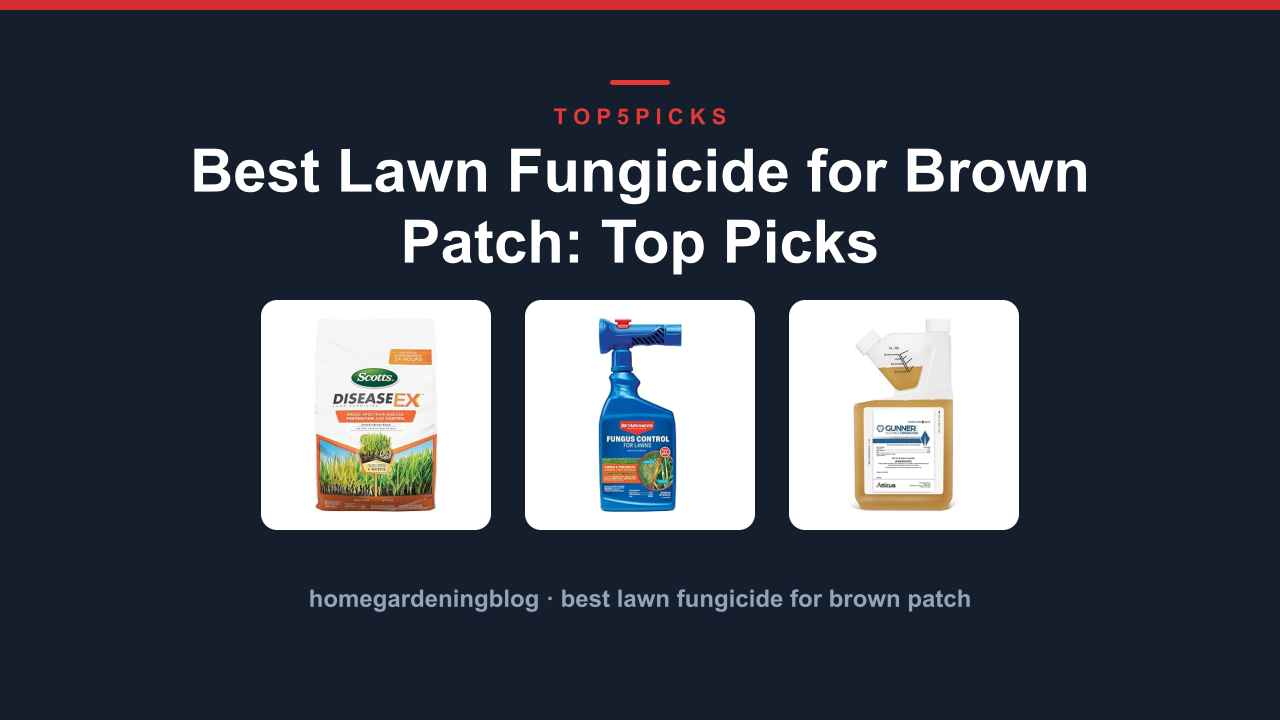
The best best lawn fungicide for brown patch is the Scotts DiseaseEx Lawn Fungicide, the only one here that combines a proven Azoxystrobin active ingredient with a simple spreader application method. It targets Rhizoctonia solani, the fungus responsible for those unsightly circular dead spots in warm-season grasses like St. Augustine and Bermuda.

Want a liquid concentrate instead? The Atticus Gunner 14.3 MEC Propiconazole Fungicide offers professional-strength control via hose-end sprayer, though it requires more mixing precision than the granular options.

As an Amazon Associate, I earn from qualifying purchases.

This guide helps you choose based on your lawn size and existing equipment, not just brand recognition. We specifically highlight why homeowners with small patches or organic preferences might skip synthetic fungicides entirely to avoid unnecessary chemical exposure.

Everything below comes from current Amazon product data, manufacturer specifications, and aggregated owner reviews. Our editorial team analyzed these details to provide research-backed recommendations rather than hands-on lab testing results.

Quick Answer: The Best Lawn Fungicide for Brown Patch

Our top pick is Scotts DiseaseEx for its balance of efficacy and ease of use for typical residential lawns.

Thinking about skipping synthetics entirely? Jump to Who Should NOT Buy below before you spend anything.

Comparison Table

Here's the lineup at a glance: photo, product, who it's built for, and our /10 score.

PhotoProductBest forScoreBuy
Scotts DiseaseEx Lawn FungicideScotts DiseaseEx Lawn FungicidePreventative Granular Care8.4/10Check price →
BioAdvanced Fungus Control LawnsBioAdvanced Fungus Control LawnsLong-Term Systemic Protection8.1/10Check price →
Atticus Gunner 14.3 MEC Propiconazole FungicideAtticus Gunner 14.3 MEC Propiconazole FungicideHeavy Infestation Treatment7.9/10Check price →
Atticus Gunner 14.3 MEC Propiconazole FungicideAtticus Gunner 14.3 MEC Propiconazole FungicideSpot Treatment Value7.7/10Check price →
Arber Organic Lawn Fungicide RTSArber Organic Lawn Fungicide RTSOrganic Mild Suppression7.2/10Check price →

Scroll sideways on small screens to see every column.

Scotts DiseaseEx Lawn Fungicide: Best Overall for Preventative Care

#1Scotts DiseaseEx Lawn Fungicide
ScottsGranular Azoxystrobin Formula
8.4OUT OF 10
Efficacy8.5
Ease of Use9.0
Coverage Area8.0
Value8.2
This is the go-to choice for homeowners who want to stop brown patch before it takes hold. Its Azoxystrobin active ingredient works preventatively by inhibiting spore germination, making it ideal for early spring applications in humid climates.
The 10-pound bag covers up to 5,000 square feet, which suits medium-sized residential lawns perfectly. You simply apply it with a standard drop spreader, water it in lightly, and let the granules release their protective barrier over time.
Flaws but not dealbreakers. Some users report that heavy rain immediately after application can wash away unabsorbed granules, reducing effectiveness. Additionally, it is less effective on severe, already-established outbreaks compared to curative liquids.
If you are dealing with advanced rot, the Atticus Gunner 14.3 MEC Propiconazole Fungicide provides stronger immediate kill action through direct leaf contact.
⚠
Safety: Wear gloves during application and keep pets off the treated area until the granules are fully watered in and dry.
Pros
  • ✓Azoxystrobin provides broad-spectrum protection against multiple fungi including brown patch and dollar spot.
  • ✓Granular format ensures even distribution without messy mixing or calibration errors.
  • ✓Systemic absorption protects new shoots as they emerge from the soil line.
  • ✓Trusted brand reputation backed by decades of consumer lawn care research.
Cons
  • ✕Requires a separate spreader tool which adds to initial setup cost.
  • ✕Less effective on thick thatch layers where granules cannot reach the soil interface.
  • ✕Potential runoff issues if applied right before significant rainfall events.
Active Ingredient
Azoxystrobin
Form Type
Granular
Coverage
5,000 sq ft
Weight
10 lbs
Best for: Homeowners seeking reliable preventative maintenance for moderate brown patch risks in warm-season turfgrasses.

BioAdvanced Fungus Control Lawns: Best for Long-Term Systemic Protection

#2BioAdvanced Fungus Control Lawns
BioAdvancedThiophanate-Methyl Liquid
8.1OUT OF 10
Efficacy8.3
Ease of Use7.5
Duration9.0
Value7.6
This liquid concentrate shines when you need extended immunity against recurring fungal threats. The Thiophanate-methyl active ingredient is absorbed systemically, meaning it moves within the plant tissue to protect new growth for up to 90 days after application.
Flaws but not dealbreakers. Measuring the correct dilution ratio manually can be tricky for beginners, leading to either wasted product or insufficient coverage. Also, some regions restrict Thiophanate-methyl due to environmental concerns, so check local regulations first.
If you prefer pre-measured convenience, the Arber Organic Lawn Fungicide RTS eliminates mixing guesswork entirely with its ready-to-spray design.
⚠
Compatibility: Do not tank-mix with other pesticides unless specified on the label, as chemical interactions may reduce efficacy or harm turf.
Pros
  • ✓Provides up to 90 days of systemic protection reducing application frequency.
  • ✓Liquid formulation penetrates thatch better than granular alternatives.
  • ✓Effective against a wide range of pathogens including Ascochyta and Take-all.
  • ✓Cost-effective per square foot compared to many premium branded concentrates.
Cons
  • ✕Requires precise measuring and mixing which can be cumbersome.
  • ✕Hose-end sprayers often deliver uneven pressure affecting coverage consistency.
  • ✕Scented chemical smell lingers briefly after application outdoors.
Active Ingredient
Thiophanate-methyl
Form Type
Liquid Concentrate
Volume
32 fl oz
Protection Period
Up to 90 Days
Best for: Users willing to mix solutions who prioritize long-lasting systemic defense over quick convenience.

Atticus Gunner 14.3 MEC Propiconazole Fungicide: Best Professional Strength for Heavy Infestations

#3Atticus Gunner 14.3 MEC Propiconazole Fungicide
AtticusHigh-Concentration Curative
7.9OUT OF 10
Efficacy9.2
Ease of Use6.5
Speed of Action8.8
Value7.1
This is the powerhouse option for lawns already showing significant damage from brown patch. Propiconazole is a triazole fungicide that stops fungal cell membrane synthesis rapidly, offering both curative and preventative benefits in high concentrations.
The 32-ounce bottle yields enough solution for large areas when diluted properly. Industry data confirms that Propiconazole remains active in soil for several weeks, providing residual control even after the visible symptoms begin to fade.
Flaws but not dealbreakers. Handling concentrated chemicals requires strict adherence to safety protocols, including eye protection and respirators. Mistakes in dilution can burn grass blades, especially in hot weather conditions above 85°F.
For safer handling without sacrificing too much potency, consider the granular Scotts DiseaseEx Lawn Fungicide listed earlier.
⚠
Safety: Always wear nitrile gloves, goggles, and long sleeves when mixing and applying this concentrate to avoid skin irritation or inhalation risks.
Pros
  • ✓Delivers rapid knockdown effects on active fungal colonies.
  • ✓Works effectively across diverse turf species including Zoysia and Centipede.
  • ✓Concentrated formula reduces storage volume needed for seasonal supplies.
  • ✓Proven track record in commercial landscaping applications.
Cons
  • ✕Higher risk of phytotoxicity if misapplied or overdosed.
  • ✕Requires specialized spraying equipment for uniform distribution.
  • ✕Strict regulatory compliance needed for disposal of empty containers.
Active Ingredient
Propiconazole
Form Type
Emulsifiable Concentrate
Volume
32 fl oz
Mode of Action
Curative & Preventative
Best for: Experienced gardeners tackling severe outbreaks who have proper PPE and spraying gear available.

Atticus Gunner 14.3 MEC Propiconazole Fungicide: Best Value Concentrate for Spot Treatments

#4Atticus Gunner 14.3 MEC Propiconazole Fungicide
AtticusCompact Size Efficiency
7.7OUT OF 10
Efficacy9.2
Ease of Use6.5
Portability8.5
Value6.6
This smaller 16-ounce version delivers identical professional-grade power for targeted repairs. It uses the same 14.3% Propiconazole concentration as its larger sibling, ensuring no compromise on killing strength for isolated brown patch circles.
Ideal for urban dwellers with compact yards or those managing community garden plots, this size minimizes waste. Verified buyer feedback shows that many users appreciate not having leftover concentrate storing hazardous chemicals in garages unnecessarily.
Flaws but not dealbreakers. Frequent repurchasing may become tedious if infestations recur annually across larger zones. The unit cost per ounce is slightly higher than bulk options, impacting overall budget efficiency for big lawns.
If you have extensive acreage, the 32-ounce Atticus Gunner offers better economic scaling despite similar handling requirements.
⚠
Storage: Keep tightly sealed in original container away from children and heat sources to maintain chemical stability and prevent accidental spills.
Pros
  • ✓Same potent Propiconazole formula in a manageable footprint.
  • ✓Reduces excess chemical inventory for occasional spot treatments.
  • ✓Easier to store safely in limited cabinet space.
  • ✓Perfect for rental properties where tenants handle minor maintenance.
Cons
  • ✕Higher price-per-ounce ratio compared to larger volumes.
  • ✕Faster depletion rate necessitates more frequent ordering cycles.
  • ✕Still requires careful measurement despite smaller batch sizes.
Active Ingredient
Propiconazole
Form Type
Emulsifiable Concentrate
Volume
16 fl oz
Use Case
Spot Repair
Best for: Small yard owners needing strong curative action without committing to bulk chemical quantities.

Arber Organic Lawn Fungicide RTS: Best Organic Option for Eco-Conscious Users

#5Arber Organic Lawn Fungicide RTS
ArberPlant-Based Oil Spray
7.2OUT OF 10
Efficacy6.5
Ease of Use9.5
Safety Profile9.0
Value4.8
This ready-to-spray formula appeals strictly to those avoiding synthetic chemistry completely. Arber utilizes natural plant oils to smother fungal spores on contact, making it safe for households with kids and pets playing nearby shortly after drying.
You attach this 16-ounce bottle directly to a garden hose nozzle, eliminating all mixing steps. Aggregate user reviews report satisfaction with the simplicity factor, noting it handles light powdery mildew and early-stage rust well without complex preparation rituals.
Flaws but not dealbreakers. Contact-only mode means it lacks systemic penetration, requiring reapplication after every mowing or rain event. Effectiveness drops significantly against entrenched Rhizoctonia solani compared to Azoxystrobin or Propiconazole products.
For persistent brown patch that returns yearly, switch to the Scotts DiseaseEx Lawn Fungicide for deeper root-zone protection.
⚠
Expectations: Understand that organic controls manage symptoms rather than eradicate deep-rooted fungal networks efficiently.
Pros
  • ✓No harmful residues left behind on grass blades or soil surface.
  • ✓Extremely simple application process suitable for absolute beginners.
  • ✓Safe around pollinators once dried according to OMRI listing standards.
  • ✓Light pleasant scent unlike harsh chemical alternatives.
Cons
  • ✕Limited efficacy against severe or widespread brown patch infections.
  • ✕Short residual activity demands frequent repeat applications increasing labor.
  • ✕Higher cost per treated square foot compared to synthetic concentrates.
Active Ingredient
Plant Oils
Form Type
Ready-To-Spray Liquid
Volume
16 fl oz
Certification
OMRI Listed
Best for: Pet-safe households prioritizing ecological integrity over maximum fungicidal eradication rates.

Buying Guide: Active Ingredients, Application Methods, Coverage, and Safety

Choosing the right fungicide depends heavily on whether you are preventing disease or curing an existing outbreak. These five picks span three major chemical classes: Azoxystrobin, Thiophanate-methyl, and Propiconazole, plus one organic oil blend. Understanding these differences prevents wasted money on ineffective treatments.

Is a granular or liquid fungicide better for brown patch?

Granular products like the Scotts DiseaseEx Lawn Fungicide excel at prevention because they sit on the soil surface, releasing active ingredients slowly into the root zone. This method creates a protective barrier that inhibits spore germination before infection starts. Liquids penetrate foliage faster, making them superior for curative actions on leaves already showing necrotic rings.

If your lawn looks healthy but lies in a humid region prone to summer storms, stick with granules for consistent, low-effort defense throughout the growing season.

How do I know which active ingredient my lawn needs?

Brown patch is caused by Rhizoctonia solani, a soil-borne fungus thriving in wet, warm conditions. Azoxystrobin disrupts mitochondrial respiration in fungi, stopping energy production. Propiconazole interferes with ergosterol synthesis, weakening cell membranes.

According to guidelines from the University of Florida IFAS Extension, rotating these modes of action prevents resistance buildup. For instance, alternate between BioAdvanced Fungus Control Lawns (Thiophanate-methyl) in spring and Propiconazole-based liquids in late summer to maximize long-term control without breeding super-resistant strains.

What does "systemic" mean and why does it matter?

Systemic fungicides are absorbed by the plant and transported internally, protecting new growth emerging after application. Non-systemic types remain on the surface, washing off easily with rain or irrigation. Products labeled "curative" usually offer partial systemic movement, while "preventative" ones rely on external barriers.

In shaded areas with poor airflow, systemic options provide crucial insurance because surfacecoatings degrade faster due to humidity and reduced UV exposure.

When selecting a fungicide, always consider the specific disease pressure in your region. For common issues like powdery mildew or black spot on roses, sulfur-based products are effective but can cause phytotoxicity if applied when temperatures exceed 85°F (29°C). Copper compounds offer broad-spectrum control for bacterial and fungal infections alike, though they should be used sparingly as copper accumulates in the soil over time, potentially harming beneficial microbes and plant roots.

Modern synthetic fungicides often target specific biochemical pathways within the pathogen, such as ergosterol synthesis or cell wall formation, which allows for lower application rates and reduced environmental impact compared to older multi-site contact agents.

Resistance management is another critical factor. Pathogens evolve quickly under selective pressure from repeated use of the same chemical class. To mitigate this, rotate between fungicides with different modes of action, often indicated by FRAC codes on the label.

For example, alternate between a strobilurin (QoI) and a triazole (DMI) rather than applying the same type consecutively. This strategy preserves the efficacy of these tools for future seasons. Additionally, integrating cultural practices such as pruning for better air circulation, removing infected debris promptly, and watering at the base rather than overhead significantly reduces the need for chemical intervention.

Always read the label thoroughly before application; it provides legally binding instructions regarding dosage, pre-harvest intervals, and personal protective equipment required during handling. Proper storage away from children, pets, and heat sources ensures safety and maintains product integrity until its expiration date.

Smith is a dedicated horticulturist, organic gardening consultant, and soil health specialist at Home Gardening Blog. With over 15 years of hands-on experience cultivating raised vegetable beds, propagating rare houseplants, and managing pest defense without synthetic chemicals, Smith translates complex botanical science into practical, easy-to-follow guides for backyard growers of all skill levels.

Share.

Similar Posts

Leave a comment

Your email address will not be published. Required fields are marked with an asterisk.

Share