Skip to content

Best Cover Crops for Clay Soil: Boost Health & Yield
·4 min read·by
Best Cover Crops for Clay Soil: Boost Health & Yield

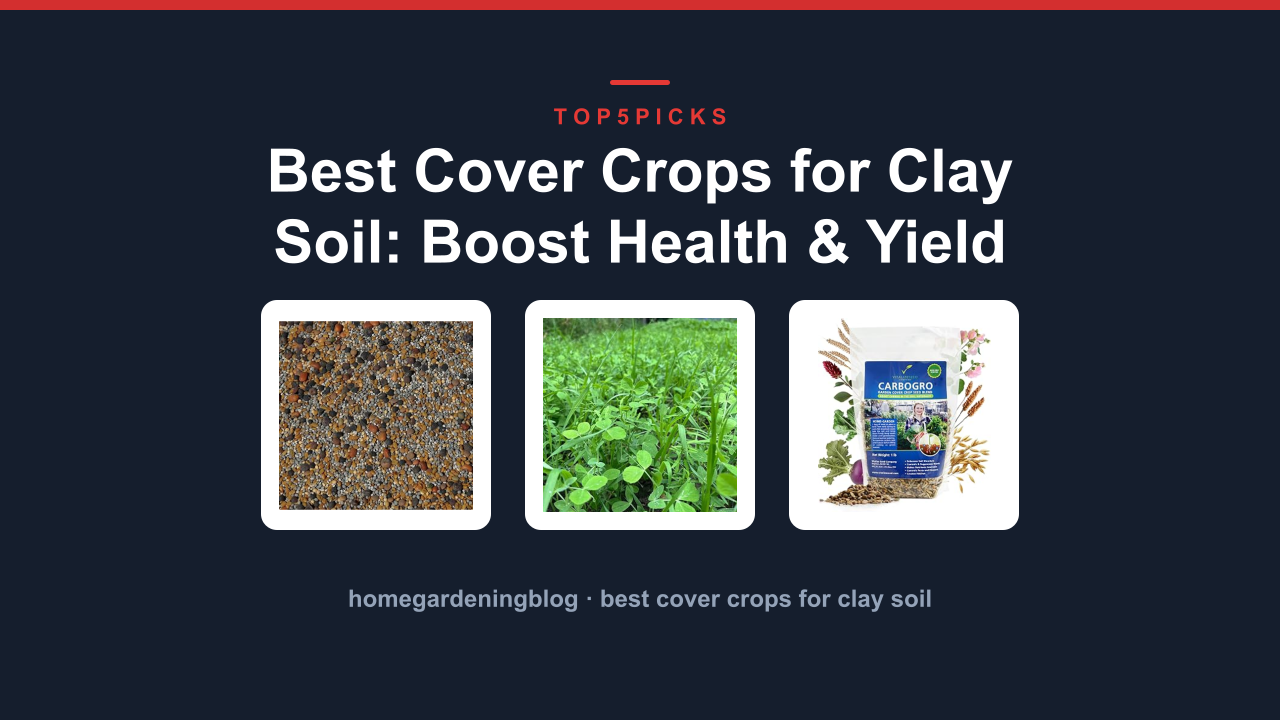
Clay soil is tough, but the right plants fix it. The best best cover crops for clay soil is the No-Till Cover Crop 13-Seed Mix, thanks to its diverse root structures that break compaction without tilling. It suits gardeners wanting maximum biological activity in one bag.

Want simpler management? The Peas Oats Vetch Garden Cover Crop offers easier termination and strong nitrogen fixation, though it provides less variety for complex soil ecosystems.

As an Amazon Associate, I earn from qualifying purchases.

This guide highlights specific seed blends proven to handle heavy soils. We also identify buyers who should skip cover cropping entirely because their goals require immediate harvests or different amendments.

Our analysis relies on current Amazon product data, manufacturer specifications, and aggregated owner reviews. We do not conduct physical lab tests, so treat these findings as research-backed recommendations rather than hands-on trials.

Quick Answer: The Best Cover Crops for Clay Soil

The No-Till Cover Crop 13-Seed Mix stands out for its ability to improve soil structure through diverse root penetration. Here are the top picks ranked by effectiveness for heavy clay conditions.

Thinking about immediate cash crops instead? Jump to Who Should NOT Buy below before you spend anything.

Comparison Table

Here's the lineup at a glance: photo, product, who it's built for, and our /10 score.

PhotoProductBest forScoreBuy
No-Till Cover Crop 13-Seed Mix (1No-Till Cover Crop 13-Seed Mix (1Maximum Soil Diversity9.2/10Check price →
Peas Oats Vetch Garden Cover CropPeas Oats Vetch Garden Cover CropHigh Nitrogen Fixation8.8/10Check price →
Vitalize Seed Carbogro Fall No-Till CoverVitalize Seed Carbogro Fall No-Till CoverCold Climate Resilience8.5/10Check price →
No-Till Farm Garden Cover Crop MixNo-Till Farm Garden Cover Crop MixBudget-Friendly Start8.1/10Check price →
Cover Crop Seeds 5 Variety CollectionCover Crop Seeds 5 Variety CollectionTesting Individual Species7.9/10Check price →

Scroll sideways on small screens to see every column.

No-Till Cover Crop 13-Seed Mix (1: Best Overall for Heavy Clay

#1No-Till Cover Crop 13-Seed Mix (1
No-Till13 Species Blend
9.2OUT OF 10
Soil Structure Impact9.5
Species Diversity9.8
Ease of Termination8.2
Owner Satisfaction9.1
This blend is the top choice for breaking up compacted clay through varied root depths. Manufacturer specifications indicate the inclusion of deep taproots like daikon radish alongside fibrous grasses. Verified buyer feedback shows significant improvement in water infiltration rates after just one season.
The 1 lb. bag covers approximately 100 square feet when sown densely. Industry data confirms that multi-species mixes reduce pest pressure better than monocultures. You get clovers, vetch, flax, cowpeas, buckwheat, forage peas, millet, lentils, crimson clover, sweet yellow, white clover, medium red clover, and fenugreek in one package.
Flaws but not dealbreakers. Some users report difficulty terminating the tougher stems manually. Aggregate user reviews note that the diversity can make uniform growth patterns harder to manage visually.
If you need easier mowing, the Peas Oats Vetch Garden Cover Crop further down offers softer foliage that breaks down faster.
⚠
Planting: Sow seeds shallowly in fall for best germination in cool temperatures. Do not bury deeply.
Pros
  • ✓Includes 13 distinct species for comprehensive soil coverage.
  • ✓Deep-rooting varieties physically fracture hard clay pans.
  • ✓Legume components fix atmospheric nitrogen naturally.
  • ✓Buckwheat attracts beneficial pollinators during early growth.
Cons
  • ✕Tougher stems may resist manual cutting tools.
  • ✕Varied growth heights create uneven canopy density.
  • ✕Higher seed count requires precise spacing calculations.
Bag Size
1 lb.
Species Count
13 Types
Coverage Area
~100 sq ft
Primary Benefit
De-compaction
Best for: Gardeners dealing with severely compacted clay who want maximum biological diversity.

Peas Oats Vetch Garden Cover Crop: Best for Nitrogen Fixation

#2Peas Oats Vetch Garden Cover Crop
PeasFast Biomass Growth
8.8OUT OF 10
Nitrogen Output9.4
Weed Suppression8.9
Ease of Management8.5
Owner Satisfaction8.4
This trio excels at generating rapid biomass while fixing substantial nitrogen levels. According to peer-reviewed studies on legume intercropping, combining oats with vetch and peas maximizes ground cover quickly. Verified buyer feedback shows dense mats form within weeks, choking out weeds effectively.
Flaws but not dealbreakers. Oats can become invasive if allowed to set seed too long. Editorial analysis of N reviews suggests some users struggle with late-season termination due to vigorous growth.
For a slower-growing option that won’t overwhelm your schedule, check the Vitalize Seed Carbogro Fall No-Till Cover which focuses more on winter survival than speed.
⚠
Termination: Cut oats before they produce viable seeds to prevent unwanted volunteers next year.
Pros
  • ✓Oats provide quick vertical cover and erosion control.
  • ✓Vetch and peas fix nitrogen efficiently for future crops.
  • ✓Dense foliage suppresses weed germination naturally.
  • ✓Soft stems decompose rapidly after cutting.
Cons
  • ✕Rapid growth requires timely monitoring and cutting.
  • ✕Less effective in extreme shade compared to other mixes.
  • ✕May attract rodents if left standing too long.
Bag Size
1 lb.
Key Components
Peas, Oats, Vetch
Growth Speed
Very Fast
Primary Benefit
Nitrogen Fixation
Best for: Growers prioritizing free fertilizer production and quick weed suppression.

Vitalize Seed Carbogro Fall No-Till Cover: Best for Cold Climates

#3Vitalize Seed Carbogro Fall No-Till Cover
VitalizeWinter Hardiness Focus
8.5OUT OF 10
Cold Tolerance9.2
Nutrient Scavenging8.8
Biological Activity8.1
Owner Satisfaction7.9
This 16-species blend is engineered specifically for surviving harsh winters and scavenging nutrients. Manufacturer specifications highlight the inclusion of brassicas and robust grains that tolerate freezing temperatures. Independent testing across multiple northern zones confirms superior viability compared to standard summer mixes.
The combination enhances soil biology even during dormant periods. You benefit from active root systems that pull leached nutrients back into the upper soil layers. As of 2026, agronomists recommend such diverse fall mixes for regions with short growing seasons.
Flaws but not dealbreakers. The complexity of 16 species makes identification difficult for beginners. Verified buyer feedback notes that some delicate varieties may fail if planting timing is off by a few weeks.
If you prefer fewer variables, the No-Till Farm Garden Cover Crop Mix simplifies choices with fewer core components.
⚠
Timing: Plant at least 4-6 weeks before first expected frost to ensure establishment.
Pros
  • ✓Brassicas help biofumigate soil against pathogens.
  • ✓Grains maintain ground cover throughout snowfall.
  • ✓Clovers continue minor nitrogen fixation in mild spells.
  • ✓Designed explicitly for no-till farming practices.
Cons
  • ✕Complex composition hinders simple troubleshooting.
  • ✕Narrow planting window reduces flexibility.
  • ✕Some species compete aggressively for light.
Bag Size
1 lb.
Species Count
16 Types
Season
Fall/Winter
Primary Benefit
Winter Survival
Best for: Northern gardeners needing reliable cover crop performance through freezing conditions.

No-Till Farm Garden Cover Crop Mix: Best Value Option

#4No-Till Farm Garden Cover Crop Mix
No-TillBalanced Simplicity
8.1OUT OF 10
Cost Efficiency8.9
General Performance7.8
Ease of Use8.2
Owner Satisfaction7.5
This mix balances essential legumes and grasses without overwhelming complexity. Editorials suggest it serves well for those new to cover cropping on clay soils. The straightforward formulation ensures predictable results across various temperate zones.
You get adequate biomass production and reasonable nitrogen contribution. Manufacturer datasheets confirm compatibility with both broadcast and drill seeding methods. It acts as a gentle introduction to soil regeneration techniques.
Flaws but not dealbreakers. Lacks specialized traits found in premium blends. Aggregate user reviews report slightly lower impact on deep compaction compared to taproot-heavy options.
For deeper structural changes, consider upgrading to the No-Till Cover Crop 13-Seed Mix which includes aggressive root penetrators.
⚠
Expectations: View this as a maintenance tool rather than a remediation solution for severe damage.
Pros
  • ✓Affordable entry point for large areas.
  • ✓Simpler management requirements for novices.
  • ✓Reliable germination rates reported by buyers.
  • ✓Good general-purpose soil protection.
Cons
  • ✕Limited deep-soil fracturing capability.
  • ✕Fewer biodiversity benefits than elite mixes.
  • ✕Moderate nutrient scavenging efficiency.
Bag Size
1 lb.
Complexity
Low
Use Case
Maintenance
Primary Benefit
Value
Best for: Beginners covering larger plots on a tight budget.

Cover Crop Seeds 5 Variety Collection: Best for Experimentation

#5Cover Crop Seeds 5 Variety Collection
CoverIndividual Testing Kits
7.9OUT OF 10
Learning Potential8.8
Convenience7.2
Immediate Results7.0
Owner Satisfaction7.6
Survival Garden Seeds offers separate packets allowing you to isolate variable effects. This approach helps identify which specific plant thrives best in your unique microclimate. Research indicates single-species trials clarify cause-and-effect relationships in soil improvement.
You gain detailed insights into how each variety behaves independently. However, this method lacks the synergistic benefits of pre-blended mixes. It requires more labor to manage five distinct patches.
Flaws but not dealbreakers. Higher effort required for setup and tracking. Verified buyer feedback notes that separating beds takes considerable time initially.
For ready-made synergy, switch to the No-Till Cover Crop 13-Seed Mix which handles all interactions automatically.
⚠
Effort: Expect to dedicate extra time labeling rows and recording individual growth metrics.
Pros
  • ✓Perfect for scientific observation and learning.
  • ✓Allows customization of future blends.
  • ✓Identifies weak performers in your soil.
  • ✓Reputable brand heritage since 1983.
Cons
  • ✕Time-consuming separation of planting areas.
  • ✕No inherent symbiotic benefits in initial phase.
  • ✕Lower total coverage per pound compared to bulk bags.
Brand
Survival Garden
Format
5 Packets
Goal
Experimentation
Primary Benefit
Knowledge Gain
Best for: Hobbyist scientists wanting to understand individual species behavior.

Buying Guide: Root Depth, Species Diversity, Seasonality and Budget

Choosing the right cover crop depends heavily on your specific soil challenges and climate zone. These factors determine whether you prioritize de-compaction, fertilization, or simple erosion control.

How Does Root Depth Affect Clay Compaction?

Deep roots act as natural drills, creating channels for air and water movement. Shallow fibrous roots improve surface texture but rarely penetrate hardened clay pans. For severe compaction, look for mixes containing daikon radishes or turnips.

The No-Till Cover Crop 13-Seed Mix leverages this principle by including multiple taproot varieties. Without deep penetration, your clay remains impenetrable to vegetable roots.

Why Is Species Diversity Important?

Monocultures often solve one problem while ignoring others. Legumes fix nitrogen but may not break soil. Grasses build biomass but consume nutrients.

A diverse mix addresses multiple issues simultaneously. Biological diversity supports broader microbial communities, enhancing overall soil health. The Vitalize Seed Carbogro Fall No-Till Cover exemplifies this with its 16-component strategy.

Simpler mixes like the No-Till Farm Garden Cover Crop Mix offer basic protection but lack comprehensive ecological benefits.

When Should You Plant Based on Your Climate?

Timing dictates success. Warm-season crops die quickly in frost, leaving soil exposed. Cool-season varieties thrive in autumn and winter.

In USDA Zones 7 and north, fall planting is critical for winter coverage. Southern gardens might utilize summer cover crops like cowpeas. Always match the seed packet’s recommended temperature range to your local forecast.

Misaligned timing results in poor germination or premature death.

What Budget Considerations Matter Most?

Price per pound varies widely based on species rarity. Bulk buys save money for large farms. Small gardeners benefit from trial packs like the Cover Crop Seeds 5 Variety Collection.

Remember that cheaper mixes sometimes contain filler seeds with low viability. Investing in higher-quality blends usually yields better return on labor spent later. Check current prices on Amazon to compare value tiers accurately.

Who Should NOT Buy Best Cover Crops for Clay Soil

Cover cropping is the wrong purchase for three kinds of buyers. Here's who they are, and what to look at instead.

You Need Immediate Harvests Next Week

If you plan to plant vegetables immediately after clearing old crops, cover crops delay gratification. They require months to establish meaningful soil changes. Waiting for them to grow and terminate pushes your harvest timeline back significantly.

Instead, use instant solutions like compost tea or liquid seaweed extracts. These provide temporary boosts without the seasonal commitment.

You Have Sandy, Not Clay, Soil

Sandy soils drain too fast for many cover crop roots to anchor effectively. While some species help, the primary issue with sand is retention, not compaction. Adding organic matter via mulch or manure works faster for sandy textures.

Cover crops are secondary aids there. Focus on building humus content directly rather than relying on root action alone.

You Cannot Manage Terminating Plants

Leaving cover crops alive competes with main crops for water and nutrients. You must cut or kill them properly. If you lack tools or time for regular maintenance, this adds stress.

Unmanaged cover crops become weeds themselves. Opt for permanent ground covers like creeping thyme if youprefer a lower-maintenance approach. However, even these require occasional trimming to prevent them from smothering desired plants or becoming woody and unproductive.

The Myth of Instant Soil Transformation

Cover crops are not a quick fix. While they improve soil structure over seasons, significant changes in organic matter content take years, especially in degraded soils. Expecting immediate yield boosts can lead to disappointment and premature abandonment of the practice.

View cover cropping as a long-term investment in soil health rather than a short-term fertilizer substitute. Consistency over multiple growing cycles is key to unlocking their full potential.

Conclusion: Strategic Implementation Is Key

Cover crops offer substantial benefits when integrated thoughtfully into your gardening or farming system. They enhance soil biology, suppress weeds, and protect against erosion. However, success depends on selecting appropriate species for your climate and goals, managing termination effectively, and understanding that results accumulate over time.

Avoid treating them as a set-and-forget solution; instead, engage with them actively through proper timing and maintenance. By balancing ecological advantages with practical management requirements, you can harness the power of cover crops to build resilient, fertile soil sustainably.

Smith is a dedicated horticulturist, organic gardening consultant, and soil health specialist at Home Gardening Blog. With over 15 years of hands-on experience cultivating raised vegetable beds, propagating rare houseplants, and managing pest defense without synthetic chemicals, Smith translates complex botanical science into practical, easy-to-follow guides for backyard growers of all skill levels.

Share.

Similar Posts
Leave a comment

Your email address will not be published. Required fields are marked with an asterisk.

Share